Objective 4: Department of the Air Force Customs and Courtesies
Saluting
The salute is one of the oldest military traditions. It is a courtesy exchanged between members of the armed forces as both a greeting and a symbol of mutual respect. Cadets adhere to DAFPAM 34-1203, Drill and Ceremonies, para 3.6 Exchange of Salutes. The uniform hat is worn and salutes are rendered in all outdoor areas, unless specifically indicated otherwise. Although inappropriate at certain times, it is never incorrect to salute a senior officer outdoors as a courtesy and a greeting. Do not salute indoors unless formally reporting in to a staff member’s office or upon receiving an award at an awards ceremony. Do not salute when reporting to enlisted staff members.
Cadets initiate the salute in time to allow the officers to return it, but not from such a distance as to hinder communication. To prescribe an exact distance for all circumstances is not practical, but good judgment indicates when salutes will be exchanged.
(NOTE: A standard practice is to use the same distance prescribed for rendering a salute to the Colors— approximately six paces.)
At no time will a cadet turn their upper body to salute someone behind them nor will they salute someone they approached from the rear. If marching, they will continue as needed. If stationary, they will use appropriate facing movements.
In detail formations (two to four cadets), all members of the detail will salute. In normal formations (five or more cadets in a flight), the cadet in charge will render the salute for the formation.
While in formation and at double-time, the formation commander may simply render a verbal greeting rather than bring the formation to quick-time to salute.
If called to receive an award, proceed in a crisp, military manner and stand approximately one arm’s length in front of the presenter. Extend the right hand and shake the presenter’s hand while taking the award with the left hand. Then render a salute if the presenter is a commissioned officer. Exit the area in a crisp, military manner. If there are multiple award presenters, side step down the line repeating the same procedure of shake, take, and salute, unless the ceremony is indoors. If indoors, only salute the presenter of the award, but shake the hands of everyone else on the line.
Reporting In/Out
Center on the door or cubicle entrance and knock once loud enough to be heard in an average size room. (Do not knock on the door or cubicle wall if a conversation is taking place in the office).
When given the order, enter, close the door if you opened it or ordered to do so, march using the most direct route to the staff member, perform the appropriate facing movement, center yourself two paces away from the individual, salute if reporting to an officer and state: “Sir/Ma’am, Cadet (last name) reports as ordered.” (If on carpet, do not square corners).
When reporting to an officer, the reporting cadet salutes and holds the salute until the officer drops their salute. Remain at the position of attention until told otherwise.
At the end of a conversation, cadets will stand and assume the position of attention and ask, “Will that be all Sir/Ma’am?” If so, take one step backwards, salute (if reporting to officers) and render the proper greeting of the day, perform the appropriate facing movement to leave, and take the most direct route out of the office or cubicle.
Multiple Cadets:
A selected cadet will center on the door or cubicle entrance and knock once loud enough to be heard in an average size room. (Do not knock on the door or cubicle wall if a conversation is taking place in the office).
When given the order, enter, close the door if you opened it or are directed to do so, march using the most direct route to the staff member, perform the appropriate facing movement, all cadets will center two paces away from the staff member with the selected cadet standing on the right, and all will salute (if officer).
This cadet will state on behalf of the others, “Sir/Ma’am, Cadets (give last names of the whole party) report as ordered.” (If on carpet, do not square corners).
All cadets will hold the salute until the officer drops their salute and remain at the position of attention until told otherwise.
At the end of the conversation, all will stand (if previously seated) and assume the position of attention and the selected cadet will ask, “Will that be all Sir/Ma’am?” If so, all cadets will take one step backwards, salute (if reporting to officers) and the selected cadet will render the proper greeting of the day. All cadets perform the appropriate facing movement to leave, and take the most direct route out of the office or cubicle. If on carpet, do not square corners.
Not Ordered to Report:
The cadet will use the preceding procedures with the following exception: instead of using the above reporting statement, use the appropriate remarks: “Sir/Ma’am, Cadet (last name) reports.” Once acknowledged by the staff member, the cadet will continue with the question or statement.**
Display of the Flag
Per AFI 34-1201 Protocol:
Position and Manner of Display:
When carried in a procession with another flag or flags, the United States Flag should be either on the marching right; that is, to the flag’s own right (to the far right of all others), or, if there is a line of other flags, in front of the centerline. The United States Flag when carried by military members is never at half-staff.

United States Flag Carried in Procession with Another Flag
The United States Flag, when it is displayed with another flag against a wall from crossed staffs, should be on the right, the flag’s own right (observer’s left), and its staff should be in front of the staff of the other flag.
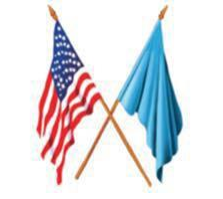
United States Flag Displayed and Another Flag Displayed with Crossed Staffs
When a number of flags are grouped and displayed from staffs radiating from a central point, and no foreign flags are in the display, the United States Flag will be in the center and at the highest point of the group.

United States Flag Displayed with Other Flags Radiating from a Central Point
When a number of flags are displayed from staffs set in a line, all staffs will be of the same height and have the same style finials, or decorative devices, at the top of the flagpoles (Service specific guidance may differ in a joint environment). The United States Flag will be at the right, which is to the left of an observer facing the display. However, if no foreign national flags are involved in the display, the United States Flag may be placed at the center of the line providing it is displayed at a higher level than the other flags in the display
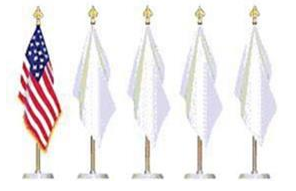
United States Flag Displayed in a Line with Other Flags at Equal Height
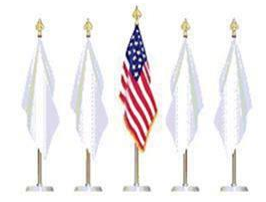
United States Flag Displayed in a Line with Other Flags at Lower Level
When flags of states, cities, localities, or pennants of societies are flown on the same halyard (rope for raising or lowering) with the United States Flag, the United States Flag should always be at the peak. When the flags are flown from adjacent staffs, the United States Flag should be hoisted first and lowered last. No flag or pennant may be placed (flown) above the United States Flag, except during church services conducted by naval chaplains at sea, when the church pennant may be flown above the flag during church services for the personnel of the Navy. When the United States Flag is flown at half-staff for an official observance, foreign national flags may be above the United States Flag.
When flags of two or more nations are displayed, they are to be flown from separate staffs of the same height. The flags should be of equal size. International usage prescribes the display of the flag of one nation equal to that of another nation in time of peace. Air Force commanders obtain instructions on the use and display of flags in foreign countries from the office of the United States Defense Attaché located in the United States Embassy. The Defense Attaché or senior Air Force officer in the foreign country concerned formulates standardized instructions in keeping with existing treaties and arrangements or practices otherwise agreeable to the host country. Inquiries relating to display of flags in foreign countries may be directed to the Secretary of the Air Force, International Affairs Division, SAF/IA.
When used on a speaker’s platform, the flag, if displayed flat, should be displayed above and behind the speaker. When displayed from a staff in a church or public auditorium, the United States Flag should hold the position of superior prominence and in the position of honor at the clergyman’s or speaker’s right as he faces the audience. Any other flag so displayed should be placed on the left of the clergyman or speaker or to the right of the audience. The flag should always be positioned at the same level or above as the clergyman or speaker, never at a lower floor level. When the flag is not on stage but placed on the floor in front of the stage, the flag is to the right of the audience.
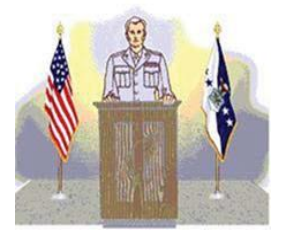
United States Flag on Stage with Speaker
When the flag is suspended across a corridor or lobby in a building with only one main entrance, it should be suspended vertically with the union of the flag to the observer’s left upon entering. If the building has more than one main entrance, the flag should be suspended vertically near the center of the corridor or lobby with the union to the north, when entrances are to the east and west or to the east when entrances are to the north and south. This includes aircraft hangars. It is permitted to have United States Flag/color team display for ceremonial events in front of and in addition to a large permanently affixed United States Flag displayed in a building or hangar.
Flags of other nations are flown or displayed in equal size and on poles of equal height, and are never flown below the United States Flag. The preferred and most traditional method is to fly flags at outside venues on individual flagpoles. The United States Flag Code does permit flags of cities, states, localities, organizations (i.e., Air Force, MAJCOM, Non-appropriated Fund (NAF), or Wing flags), pennants of societies or special flags such as commemorative/AF Anniversary, Minuteman, or Prisoner of War/Missing in Action (POW/MIA) flags to be flown on the same halyard with the United States Flag. They should be fastened to the halyard at a distance below the United States Flag so that when both are at rest the United States Flag does not touch or overlap the second flag. When the flags are flown from adjacent staffs, the United States Flag should be hoisted first and lowered last.
Order of Precedence of Flags:
The United States Flag.
Foreign national flags.
Normally, these are displayed in alphabetical order using the English alphabet. At the North Atlantic Treaty Organization (NATO) Headquarters, NATO member country flags are displayed in alphabetical order by their native country name (i.e., Deutschland vice Germany).
Flag of the President of the United States of America.
State and territorial flags.
State flags should be displayed in order of admittance of the state to the Union. Territorial flags, when displayed, are displayed after the state flags in the order they were recognized by the United States.
City Flags
Departmental Flags
Military organizational flags of the Services in order of precedence:
Cadets, United States Military Academy
Midshipmen, United States Naval Academy
Cadets, United States Air Force Academy
Cadets, United States Coast Guard Academy
Midshipmen, United States Merchant Marine Academy
United States Army
United States Marine Corps
United States Navy
United States Air Force
United States Coast Guard
United States Space Force
Army National Guard of the United States
Army Reserve
Marine Corps Reserve
Naval Reserve
Air National Guard of the United States
Air Force Reserve
Coast Guard Reserve
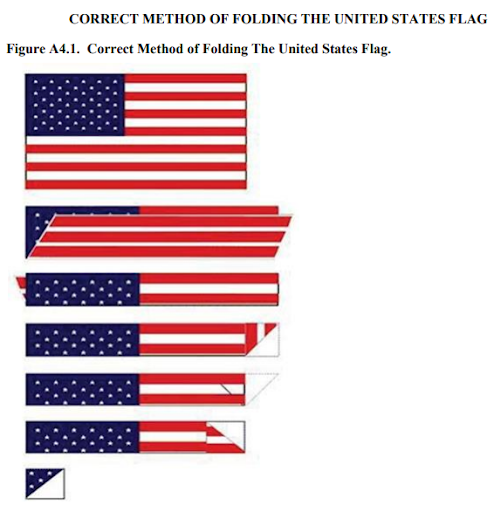
Folding of the Flag
Per AFI 34-1201 Protocol:
Reveille
The Detail Commander will call Standby, Detail Fall In
All commands except sound reveille and attention to the colors will be done in a hushed tone.
The Detail Commander will Fall In behind the Front Halyard for Reveille
Shortly after the highest-ranking member of Cadre has formed the Flight, the Detail Commander will give Forward MARCH
Cadence is allowed but it must also be done in a hushed tone
Slightly before the Front Halyard passes the flagstaff the Detail Commander will give a Left Flank MARCH then immediately Detail HALT
The Detail Commander will order SOUND REVEILLE then immediately order Parade REST
The Detail will stay at Parade Rest until the end of Reveille
The Detail Commander will order Detail ATTENTION then will order post three times
On the First POST the Halyards will take one step forward
On the second POST the Halyards will face inwards toward the flagstaff
On the third POST the Halyards will take one step towards the flagstaff
The Front Halyard will then take the halyards and hand off one to the rear Halyard
With a small head nod from the Front Halyard both Halyards will take a small step back to make the halyard taut
Halyards will then lower the halyard until the final clip is in the Front Halyard’s hands
The Detail Commander will hand the union to the Front Halyard, then the Front Halyard will attach the clip. The Detail Commander and Front Halyard will repeat the same process with the bottom clip of the US flag
The POW/MIA Flag Bearer will then repeat the same process with the Front Halyard and the POW/MIA flag
The Detail Commander and POW/MIA Flag Bearer will hold both their flags until after the flag is hoisted clear of their grasp
The Detail Commander will order ATTENTION TO THE COLORS which signals the Halyards to raise the flags and the playing of “To the Colors”
After the flag has left their grasp the Detail Commander will order Present ARMS
Once the flags are hoisted, the Rear Halyard will hand their halyard back to the Front Halyard. The Rear Halyard then executes present arms.
The Front Halyard will secure the halyard to the flagstaff then execute present arms
The Detail Commander will command Order ARMS then order post three times
On the first POST the Halyards will take one step back
On the second POST the Halyards will face towards the Flag Bearers and the Flag Bearers will perform a left face
On the third POST the Halyards will take one step forward and the Flag Bearers will perform a left face
The Detail Commander will order Forward MARCH then immediately Right Flank MARCH
Once back to where the detail fell in, the Detail Commander will order Detail HALT and Fallout
Retreat
The Detail Commander will call Standby, Detail Fall In
All commands except sound retreat and attention to the colors will be done in a hushed tone
The Detail Commander will Fall In in front of the Rear Halyard for Retreat
Shortly after the highest-ranking member of Cadre has formed the Flight, the Detail Commander will give Forward MARCH
Cadence is allowed but it must also be done in a hushed tone
Slightly before the Front Halyard passes the flagstaff the Detail Commander will give a Left Flank MARCH then immediately Detail HALT
The Detail Commander will order SOUND RETREAT then immediately order Parade REST
The Detail will stay at Parade Rest until the end of Retreat
The Detail Commander will order Detail ATTENTION then will order post three times
On the First POST the Halyards will take one step forward
On the second POST the Halyards will face inwards toward the flagstaff
On the third POST the Halyards will take one step towards the flagstaff
The Front Halyard will then take the halyards and hand off one to the rear Halyard
With a small head nod from the Front Halyard both Halyards will take a small step back to make the halyard taut
The Detail Commander will order ATTENTION TO THE COLORS
The Halyards will then lower the flags at a slow pace and the Detail Commander will order Present ARMS
If the flag is at half-staff, the Halyards will hoist the flags at a brisk pace to the top of the flagstaff, then lower the flags at a slow pace
Once the flags are within view the Detail Commander will command: Order ARMS and both flags will be secured by their respective bearer
Once the flags are unclipped and secured the Halyards will hoist the halyard to the top of that flagstaff at a brisk pace
The Rear Halyard will hand off the halyard to the Front Halyard and the Front Halyard will secure it to the flagstaff
The Detail Commander will then order post three times
On the first POST the Halyards will take one step back
On the second POST the Halyards will face towards the Flag Bearers and the Flag Bearers will perform a left face
On the third POST the Halyards will take one step forward and the Flag Bearers will perform a left face
The Detail Commander reports to the highest-ranking cadre member present: Sir/Ma’am the colors are secured
Preferably, address Cadre with their rank and name
The Detail Commander will order Forward MARCH then immediately Right Flank MARCH
Once back to where the detail fell in, the Detail Commander will order Detail HALT and Fallout