Objective 7: Drill Positions and Movement

Reference: DAFPAM 34-1203

Fundamentals and Stationary Movements

Position of Attention
Bring heels together and in line with each other, feet should be turned out equally forming a 45-degree angle. Keep legs straight without locking or bending the knees. Body is upright with hips level, chest lifted, back arched, and shoulders square/even. Arms hang straight down alongside the body. Place thumbs, which are resting along the first joint of the forefinger, along the seams of the trousers or sides of the skirt. Hands are cupped (but not clenched as a fist) with palms facing the leg. Chin can be drawn in so the head rests vertically on the neck. Eyes are to the front, caged, with parallel line of sight to the ground. Silence and immobility are required.
Parade Rest
The command is “Parade, REST”. On the command “REST”, raise the left foot just enough to clear the ground and move it to the left so your heels are 12 inches apart (as measured from the inside of the heels). Keep the legs straight, but not stiff, and the heels on line. Bring the arms, fully extended, to the back of the body. With palms outward, the tip of the right middle finger should rest on the tip of the left middle finger. The palms will face outwards. Place the right hand in the palm of the left, right thumb over the left to form an “X”. Keep head and eyes straight ahead, and remain silent and immobile.
At Ease
The command is “AT EASE”. On the command “AT EASE”, relax in a standing position, but keep the right foot in place. Position in the formation will not change, and silence will be maintained.
Rest
The command is “REST”. On the command “REST”, the same requirements for at ease apply, but moderate speech is permitted.
Fall Out
The command is “FALL OUT”. On the command “FALL OUT”, individuals may relax in a standing position or break ranks. They must remain in the immediate area, and no specific method of dispersal is required. Moderate speech is permitted.
Resuming Position of Attention
To resume the position of attention from any of the rests (except fall out), the command is (for example) “Flight, ATTENTION”. On the command Flight, assume the position of parade rest; and at the command “ATTENTION”, assume the position of attention.
Facing Movements
Execute facing movements from a halt, at the position of attention, and in the cadence of quick time. Perform facing movements in two counts.
Right (Left) Face: The commands are “Right (Left), FACE”. On the command “FACE”, raise the right (left) toe and left (right) heel slightly and pivot 90 degrees to the right (left) on the ball of the left (right) foot and the heel of the right (left) foot, assisted by slight pressure on the ball of the left (right) foot. Keep legs straight, but not stiff. The upper portion of the body remains at attention. Next, bring the left (right) foot forward, ensuring heels are together and on line. Feet should now be forming a 45-degree angle.
About Face: The command is “About, FACE”. On the command “FACE” lift the right foot and place the ball of the right foot approximately half a shoe length behind and slightly left of the left heel. Distribute weight to the ball of the right foot and heel of the left. Keeping the upper body at attention, pivot 180 degrees to the right on the ball of the right foot and the heel of the left. Suspend arm swing during the movement, and remain as though at attention. On completion of the pivot, heels should be together and on line and feet should form a 45-degree angle.
Half Right (Left) Face: For 45-degree movements, the command Half Right (Left), FACE may be used. The procedures are identical to Left and Right Face but used 45-degree turns instead of 90-degree turns.
Present Arms/Order Arms
The commands are “Present, ARMS” and “Order ARMS”. On the command “PRESENT, ARMS”, Raise the right hand in the most direct manner while at the same time extending and joining the fingers. Keep the palm flat and facing the body. Place the thumb along the forefingers, keeping the palm flat and forming a straight line from fingertips to elbow. Tilt the palm slightly toward the face. Hold the upper arm horizontally. Ensure the tip of the middle finger touches the right front corner of headdress/glasses, or the outside corner of the right eyebrow. At the command “ORDER, ARMS”, return your hand to your side and resume the position of attention.
Dress Right Dress
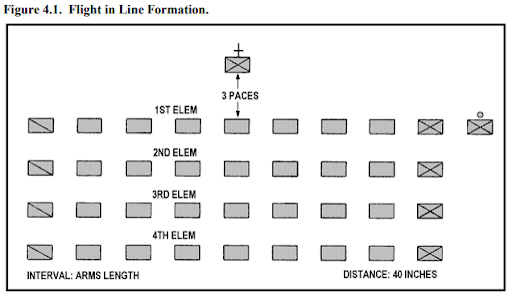
Normal Interval: The commands are “Dress Right, DRESS” and “Ready, FRONT”. On the command “DRESS”, everyone except the last person in each element raises and extends the left arm laterally from the shoulder so the arm is parallel with the ground. As the arm is raised, un-cup the hand, keeping the palm down. Extend and join the fingers and place the thumb along the forefinger. At the same time as the left arm is raised, each individual (except the guide and element leaders) turns head and eyes 45-degrees to the right with snap. The leading individual of each file establishes normal interval (by taking small choppy steps and aligning with the base file) and establishes exact shoulder-to-fingertip contact with the individual to the immediate right. The second, third, and fourth element leaders align themselves directly behind the person in front of them (using small choppy steps) and visually establish a 40-inch distance. As the remaining members align themselves behind the individual in front of or to the right of them, their shoulders may or may not touch the fingertips of the individual to their right. If the arm is too long, place the extended hand behind the shoulder of the individual to the left. If the arm is too short, leave it extended toward the individual to the left and parallel to the ground. Once dress, cover, interval, and distance (DCID) have been established, the command Ready, FRONT will be given. On this command, Airmen whose arms are up will lower their arms with snap to their sides (without slapping their sides) and re-cup their hands when their arm is at approximately waist level. As the arm is lowered, Airmen whose heads are turned will return their heads to the front with snap. The body is now back to the position of attention.
Close Interval: The command is At Close Interval, Dress Right, DRESS. On this command, all Airmen except the last one in each element will raise their left hand so the heel of the hand rests on the left hip, fingers are extended and joined, thumb is along the forefinger, fingertips point toward the ground, and the elbow in line with the body. At the same time the left hand is raised, all Airmen except the guide and second, third, and fourth element leaders will turn their head and eyes 45 degrees to the right. First element Airmen establish the interval by ensuring their upper right arm touches the extended elbow of the individual to their right. The same procedures used to establish DCID for normal interval will be used for close interval. At Close Interval, Dress Right (Left), DRESS is not given to a flight at normal interval, and Dress Right (Left), DRESS is not given to a flight at close interval

Basic Flight Drill

Line and Inverted Line Formation

A flight forms in at least two, but not more than four, elements in line formation. The command is FALL IN.
_images/Obj_7_1.png

Column and Inverted Column Formation

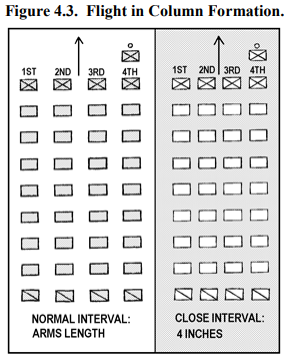
A flight forms in at least two, but not more than four, elements in line formation. The command is FALL IN.
Cover
Column Formation: To align the flight in column, the command is COVER. On this command, everyone except the guide adjusts by taking small choppy steps if needed and establishes dress, cover, interval, and distance. The leading individual of each file (excluding the base file) obtains the proper interval (normal or close). The base file, the file on which a movement is planned, regulated, or aligned, establishes and maintains a 40-inch distance. All others align themselves beside the individual to their right and behind the individual in front of them.

Inverted Column Formation: (GENERALLY NOT RECOMMENDED). The same command and procedures used to reestablish dress, cover, interval, and distance while in column formation are used in inverted column. The exception to this is the leading individual of the base element does not move and everyone else establishes dress, cover, interval, and distance based on this individual.
_images/Obj_7_2.png
Forward March
To march forward from a halt, the command is “FORWARD, MARCH”. On the command “MARCH”, step off straight ahead with the left foot, taking a 24- inch step (measured from heel to heel), and place the heel on the ground first. Use coordinated arm swing: right arm forward with the left leg and left arm forward with the right leg. Cup the hands with the thumbs pointed down, hang arms straight but not stiff and swing the arms naturally. Measure the swing 6 inches to the front (measured from the rear of the hand to the front of the thigh) and 3 inches to the rear (measured from the front of the hand to the back of the thigh). If applicable, maintain proper dress, cover, interval, and distance and adhere to cadence. Count cadence as follows: “HUP, TOOP, THREEP, FOURP”. One and Three should be on the left foot with two and four on the right. The pattern is called twice (8 beats) with a rest of 8 beats in between (8 on 8 off).
Halt
To halt from quick time, the command is “FLIGHT, HALT”, given as either foot strikes the ground. On the command “HALT”, take one more 24-inch step. Next, the trailing foot will be brought alongside the front foot. The heels will be together, on line, and form a 45-degree angle. Coordinated arm swing will cease as the weight of the body shifts to the leading foot when halting. “COVER” should be called immediately after.
Mark-Time
The command is “Mark Time, MARCH”. When marching, the command “MARCH” is given as either foot strikes the ground. Take one more 24-inch step with the right (left) foot and then bring the trailing foot to a position so both heels are on line. The cadence is continued by alternately raising and lowering each foot. The balls of the feet are raised 4 inches above the ground. Normal arm swing is maintained.
To resume marching, the command “Forward, MARCH” is given as the heel of the left foot strikes the ground. The Airman takes one more step in place and then steps off in a full 24-inch step with the left foot.

Intermediate Flight Drill

Column Movements
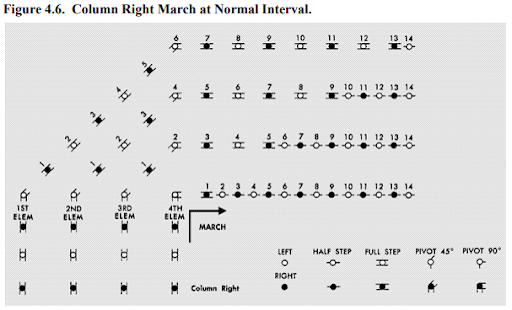
The command is “COLUMN RIGHT (LEFT) MARCH”. The command is called on the right foot if going to the right and called on the left foot if going left. The inside element makes an immediate 90-degree turn and goes into half-step. The middle element pivots 45-degrees, takes one step, pivots another 45-degrees on the next step, and enters half-step. The outside element pivots 45-degrees, takes three steps, pivots another 45-degrees on the next step, and enters half-step.
The guide performs the pivots and steps exactly as the element leader to which they are affixed. Following completion of the pivots, the guide continues in a 24-inch step until he or she is ahead of the fourth element leader. The guide pivots 45 degrees to a position in front of the fourth element leader; then he or she pivots 45 degrees again toward the front and begins half stepping.
Once the entire formation has changed direction and dress, cover, interval, and distance are reestablished, Forward March will be called to resume normal marching.
_images/Obj_7_3.png
Column Half Right (Left): The Command, “COLUMN HALF RIGHT (LEFT) MARCH”, is called on the right foot if going right and left foot if going left. Differing from a normal Column Right (Left), all three element leaders turn 45 degrees simultaneously. The first element leader will go to half-step, joined by the second, until all three are in-line with each other. Once they are, they will automatically resume the normal 24-inch step (no forward march is called after the movement is completed).
Flanking Movements
The command is Right (Left) Flank, MARCH, given as the heel of the right (left) foot strikes the ground. On the command MARCH, the Airman takes one more 24-inch step, pivots 90 degrees to the right (left) on the ball of the left (right) foot, keeping the upper portion of the body at the position of attention. Then step off with the right (left) foot in the new direction of march with a full 24-inch step and coordinated arm swing. Arm swing is suspended to the sides as the weight of the body comes forward on the pivot foot. The pivot and step off are executed in one count. This movement is used for a quick movement to the right or left for short distances only. Throughout the movement, maintain proper dress, cover, interval, and distance.
Left / Right Step
The command is Right (Left) Step, MARCH, given only from a halt and for moving short distances. On the command MARCH, the Airman raises the right (left) leg from the hip just high enough to clear the ground. The leg will be kept straight, but not stiff, throughout the movement. The individual places the right (left) foot 12 inches, as measured from the inside of the heels, to the right (left) of the left (right) foot. Transfer the weight of the body to the right (left) foot, then bring the left (right) foot (without scraping the ground) smartly to a position alongside the right (left) foot as in the position of attention. This movement is continued in quick time; the upper portion of the body remains at attention and arms remain at the sides throughout.
Cadence may be counted during this movement. Counts one and three are given as the right (left) foot strikes the ground. Counts two and four are given as the heels come together.
To halt from the right (left) step, the preparatory command and command of execution are given as the heels come together. The halt from the right (left) step is executed in two counts. On the command HALT, one more step is taken with the right (left) foot and the left (right) foot is placed smartly alongside the right (left) foot as in the position of attention.
To the Rear
The command is “To the Rear, MARCH”, given as the heel of the right foot strikes the ground. On the command “MARCH”, take a 12-inch step with the left foot, placing it in front of and in line with the right foot and distribute the weight of the body on the balls of both feet. Then pivot on the balls of both feet, turning 180 degrees to the right, and take a 12-inch step with the left foot in the new direction, with coordinated arm swing, before taking a full 24-inch step with the right foot. While pivoting, do not force the body up or lean forward. The pivot takes a full count and the arm swing is suspended to the sides as the weight of the body comes forward while executing the pivot, as if at the position of attention.
Double Time / Quick Time
To march in double time from a halt or when marching in quick time, the command is “DOUBLE TIME, MARCH”.
When halted and on the command “MARCH”, begin with the left foot, raise the forearms to a horizontal position along the waistline, cup the hands with the knuckles out, and begin an easy run of 180 steps per minute with 30-inch steps, measured from heel to heel. Coordinated motion of the arms is maintained throughout.
When marching in quick time and on the command MARCH (given as either foot strikes the ground), the Airman takes one more step in quick time and then steps off in double time.
To resume quick time from double time, the command is Quick Time, MARCH, with four steps between commands. On the command MARCH (given as either foot strikes the ground), the Airman advances two more steps in double time, resumes quick time, lowers the arms to the sides, and resumes coordinated arm swing.
To halt from double time, the command Flight, HALT is given as either foot strikes the ground, with four steps between commands. Take two more steps in double time and halt in two counts at quick time, lowering the arms to the sides.
The only commands that can be given while in double time are Incline To The Right (Left); Quick Time, MARCH; and Flight, HALT.
Route Step
Route Step March. The command is Route Step, MARCH. On the command MARCH, the Airman takes one more 24-inch step and assumes route step. Neither silence nor cadence is required, and movement is permitted as long as dress, cover, interval, and distance are maintained.
Marching Other Than at Attention: The commands below may be given as the heel of either foot strikes the ground as long as both the preparatory command and command of execution are given on the same foot and only from QuickTime. The only command that can be given when marching at other than attention is Incline to the Right (Left). Specific instructions may be given to maintain control of the flight. Example: “Guide, incline 90 degrees to the Right; Guide, incline 45 degrees to the Left”. Otherwise, the flight must be called to attention before other commands may be given
Transfer of Command


Note for this example “Cadet A” will be the starting FLT/CC, and “Cadet B” will be the one replacing them.
  1. Firstly, the FLT/CC, Cadet A, will command “Cadet B, front and center”. This should be monotone and quick, no change in pitch/sing song inflection.

  2. Cadet B will fall out of the flight and make their way around the left side of the flight.

  3. Cadet B will stand in front of Cadet A at attention, salute, and say “Cadet A, Cadet B reports as ordered.”

  4. At this point Cadet A will drop their salute, and will be the first to do so. (They are still in command) A will say “Cadet B, take control of the flight.”

  5. After a moment both cadets will take a step with arm swings. Cadet A will take a step backward with their RIGHT foot, Cadet B will take a step forward with their LEFT. This needs to be in sync! ← Hardest part

  6. Cadet A will now salute Cadet B and state the following; “Cadet B, Cadet A requests permission to fall into the rear of the flight.”

  7. Cadet B will respond with “Fall into the rear of the flight.”

  8. Once Cadet B drops their salute, Cadet A will drop theirs, and make their way to the rear of the flight. (Note that Cadet B is now in command and drops salute first)

  9. Important Notes:

    • Cadet A should go to the rearmost spot in the flight no matter where the deputy is. They should also ignore the hole in the flight.

    • Cadets cannot return to ranks if they were never in the flight.

    • Cadet B first command should be preceded by “By my command!”

Advanced Flight Drill

Column of Files
To form a single file when in a column of two or more elements, the command is “Column of Files from the Right (Left), Forward, MARCH”. If the movement is from the left, the guide takes a position in front of the file that will move first upon hearing the informational command, and remains at carry guidon. On the preparatory command, the element leader of the right (left) element turns his or her head 45-degrees to the right (left) and commands Forward. At the same time, the remaining element leaders turn their heads 45-degrees to the right (left) and command STAND FAST. Their heads are kept to the right (left) until they step off. On the command MARCH, the extreme right (left) element steps off. The element leader of each remaining element commands “Forward, MARCH” as the last Airman in each element passes, ensuring the leader’s element is in step with the preceding element. All elements then incline to the right (left), following the leading elements in successive order.
Column of Files, Column Half Right (Left): In conjunction with forming single files, column movements may be executed at the same time. The command is Column of Files From the Right (Left), Column Right (Left). On the informational command, the guide executing a face in marching takes a position in front of the file that will move first. On the preparatory command, the element leader of the right (left) element commands Column Right (Left). The remaining element leaders command STAND FAST. On the command MARCH, the element leader and guide execute a face in marching to the right (left), and the element leader continues marching in the new direction with 24-inch steps. The guide marches to a position ahead of the element leader, then pivots 45 degrees to a position 40 inches in front of the element leader. The remaining individuals in the base file march forward on the command of execution, pivot in approximately the same location as their element leader, and maintain a 40-inch distance. The element leaders of the remaining elements command Column Right (Left), MARCH, at which time all Airmen perform the movement in the same manner as the base element. The element leaders follow the leading elements in successive order. All members of the formation continue taking 12” steps until receiving the command Forward MARCH.
Column of Twos (Fours) From a Single File (Multiple Elements): To form a column of two or more files when in a single file of more than one element, the command is Column of Twos (Fours) to the Left (Right). On the informational command, the leading element leader turns his or her head 45 degrees to the right (left) and commands STAND FAST. At the same time, the remaining element leaders turn their heads 45-degrees to the right (left) and command Column Half Left (Right). On the command MARCH, the leading element stands fast, and the element leader returns his or her head back to the front. The remaining element leaders turn their heads back to the front and step off, executing a column half left (right) simultaneously, and incline and form to the left (right) of the leading element. The remaining members of each element march to the approximate pivot point established by the element leaders and perform the movement in the same manner as the element leaders. Each element is halted by its element leader turning his or her head 45-degrees to the left (right) and commanding the element to halt so his or her element is abreast of, and even with, the leading element.
Counter March
This is not a precise movement, but it is used to permit flexibility in the movement of units where space is limited. The command is “Counter, MARCH”. The following is executed on the command MARCH:
The first element leader takes four 24-inch steps forward and executes a 90-degree pivot to the right (suspending arm swing during the pivot), marches across the front of the flight just beyond the fourth element, and executes another 90-degree pivot to the right (again suspending arm swing). Each succeeding member marches to the approximate pivot points established by the person in front of him or her and performs the same procedures as the first element leader.
The second element leader takes two 24-inch steps forward and executes a 90-degree pivot to the right with suspended arm swing. He or she continues to march and executes another 90-degree pivot to the right (with suspended arm swing) between the third and fourth elements. Each succeeding member marches to the pivot points established by the person in front of him or her and performs the same procedures as the second element leader.
The third element leader takes one 24-inch step forward, executes two 90-degree pivots to the left (with suspended arm swing during the pivots), and marches between the remainder of the third and second elements. Each succeeding member marches to the approximate pivot points established by the person in front of him or her and performs the same procedures as the third element leader.
The fourth element leader takes three 24-inch steps forward and executes a 90-degree pivot to the left with suspended arm swing. The element leader then marches across the front of the flight and executes another 90-degree pivot to the left between the first and second elements, suspending arm swing during the pivot. Each succeeding member marches to the approximate pivot points established by the person in front of him or her and performs the same procedures as the fourth element leader.
The guide performs this movement in approximately the same manner as the fourth element leader, staying in front of the fourth element leader in the most practical manner.
As the fourth element leader marches past the last Airman in the fourth element, the fourth element leader and the individuals of the file begin marching in a half step. The remaining element leaders begin the half step once they pass the last individual in each file. After the element leaders pass the last individual in each file, they incline, as necessary, to obtain close or normal interval; then they begin the half step. Forward MARCH will be given once all Airmen have completed the movement and proper dress, cover, interval, and distance have been established.
Halted: This movement is performed in the same manner as if marching, but with the following exceptions: prior to executing the movement, the first element leader takes five paces forward, the second element leader takes three paces forward, the third element leader takes two paces forward, and the fourth element leader takes four paces forward.

Formations


Detail:

  • Formation of two to four cadets.

  • In details of two, the detail leader marches on the right.

  • In details with three or four cadets, the cadet in the right rear position will lead the detail.

  • When in a detail to retrieve a guidon, the cadet on the right will carry it, regardless of their assigned duty for that day.

Flight:

  • Formation of five or more cadets.

  • This includes a designated flight leader, usually the Cadet Flt/CC.

  • There will be at least two, but no more than four, elements.

Positions / Roles Within the Formation

Guide:

  • The guide marches, without a guidon, in front of the highest numbered element leader.

  • Will regulate the direction and rate of marching (front-right corner when in column formation).

Guidon Bearer:

  • The guidon bearer marches, with a guidon, in either a detail of two or a flight with six or more cadets (Cadet Flt/CC, four cadets, and a guidon bearer). - They assume the same position as the guide in a formation.

  • The guidon bearer will perform all proper movements in accordance with DAFPAM 34-1203, Chapter 5, Section C.

Road Guard:

  • Cadet(s) designated to stop traffic when cadets cross a road or parking lot.

  • Located in the rear of the flight (in front of the Cadet Flt/CD).

Element Leader:

  • The leader of the smallest drill unit comprised of at least 3, but usually 8 to 12 individuals, one of whom is designated the element leader.

Detail Marching


  • Detail marching procedures must be used when 2 to 4 cadets are transiting.

  • In details of 2, the detail commander marches on the right.

  • In details with 3 or 4 cadets, the detail is sized placing the taller cadets in the rear of the formation.

  • In this formation, the cadet in the right rear position is the detail commander.

  • The detail commander will render all greetings, just as he/she would if they were a flight commander.

  • When a detail retrieves a guidon, the cadet on the right (or right front in formations of 3 to 4 cadets) will carry the guidon, regardless of their assigned duty for that day.

  • When on improved surfaces, the detail commander will command “Detail, FALL IN.”

  • Once the detail is in the proper formation, the detail commander will give proper commands to move his/her detail from one location to the next as quickly as possible.

  • When on unimproved surfaces, the detail commander will command “Detail, FALL IN.”

  • Once the detail is in the proper formation, the detail commander will command “At ease, MARCH,” at which time the detail will take one 24-inch step and assume marching at ease.

  • During at ease march, the only command that may be given is Incline to the Right (Left).

  • The detail must be at attention to call any other commands.

Squadron Marching

A Squadron must consist of two or more flights. Flights should form up in line formation, but do not execute marching in line except for small changes in position.
Flight commanders repeat the preparatory commands of the squadron commander for facings, steps, and marching except when the command “SQUADRON” is given, if so Flt/CC echoes “FLIGHT”.
When flights are meant to execute a movement in successive order (Ex: a column movement), the commander of the first flight repeats the preparatory command, while the commanders of the other flights command “CONTINUE THE MARCH”. When successive flights get to the approximate position where the command was called, they will command their flight accordingly.
If the distance between flights is incorrect, the squadron commander will command “CLOSE ON LEADING FLIGHT” upon this command the first flight will go into half step, when the flights behind catch up, their flight commander will command their flight to half step to maintain DCID between flights. Once the spacing is corrected, the squadron commander will call “Forward, MARCH”.
When giving commands, Flight commanders may include the letter or name of their flight (i.e., “Golf flight, HALT”)
The squadron commander has autonomy during squadron marching, and may assign positions to others as needed. They may also make corrections to specific flights.
Proper road guard procedures must be followed. The squadron commander will call road guards out for the first flight, it is up to each following flight to send out their own road guards for themselves.
The squadron commander may command “INITIATE ROLLING CADENCE” upon which the first flight commander will give an 8-count cadence, then immediately after the second will do so, and so on. When the last flight commander has done an 8-count the first will begin and the whole process repeats. Before calling another command, the Squadron Commander must end the rolling cadence by commanding “CEASE ROLLING CADENCE”.
Dress, Cover, Interval, & Distance (DCID) for squadron marching:
Before marching the squadron, the commander will command “Key personnel, POST”. Upon this command, Flt/CC’s will stand in front of the first element leader, in the front left of the flight. The guidon bearer will be to their right. When Flt/CC’s give commands at this position, they will turn their head to the right and give their command.
Proper distance between flights is measured from the deputy of the flight in front to the guidon bearer of the rear flight. The proper distance is 3 paces between flights.
The Squadron Commander should be 9 paces away and in the rear two thirds of the flight. Although as stated above they have lots of autonomy if a proper solution is used.

Guidon Procedures

  • Each flight of six or more cadets will carry their guidon.

  • Flight guides are responsible for storing the guidon in the appropriate rack when not in use.

  • Guidons will not be placed with the tip of the ornament on the ground or with the pennant wrapped tightly around the staff.

  • If entering a building that does not have a storage rack, cadets will take the guidon inside with them and place it out of the way, leaning into a corner so that it will not fall.

  • When entering a building with a guidon, cadets will announce “GUIDON” in order to alert others in the area to the hazard.)

Open Rank Inspections (ORIs)


Open ranks inspections focus on military bearing and personal appearance. Any cadet who receives a total of four or more discrepancies during a single open ranks inspection will be counseled appropriately.

  1. Flights being inspected will march to the inspection area, position themselves at the proper location, and stand at parade rest.

  2. The Cadet Flt/CC will be posted six paces to the front of, centered on, and facing away from the flight.

  3. When the inspector approaches, the Cadet Flt/CC will call the flight to attention, salute the inspector, and offer a verbal greeting. The inspector will direct the Cadet Flt/CC to prepare the flight for inspection at which time the Cadet Flt/CC salutes the inspector and does an about face.

  4. The Cadet Flt/CC then gives the command “Open ranks, March,” and then immediately walks at a 45-degree angle to position him/herself one pace to the guidon bearer’s right side and then faces down the line.

  5. The Cadet Flt/CC then proceeds to align the flight starting with the First Element and ending with the Third Element

  6. Once the flight is aligned, the Cadet Flt/CC positions him/herself three paces in front of the guidon bearer’s right side, facing down the line. The first element will now be three paces to the left of the Cadet Flt/CC.

  7. The Cadet Flt/CC will command “Ready front.”

  8. The Cadet Flt/CC takes one step forward, conducts a right face, and salutes the inspector (who has positioned him/herself immediately in front of the Cadet Flt/CC) and reports, “Sir (Ma’am), ___ Flight is prepared for inspection.” The inspector returns the salute and begins to inspect the Cadet Flt/CC.

  9. While the Cadet Flt/CC is being inspected, the Cadet Flt/CD takes one step to the rear, conducts a right face, and marches to a position one pace to the right and one pace to the front of the guide. He/she faces down line and prepares to record the inspection results.

  10. nce finished inspecting the Cadet Flt/CC, the inspector asks the Cadet Flt/CC to accompany him/her on the inspection. Both the Cadet Flt/CC and Cadet Flt/CD will accompany the inspector; the Cadet Flt/CD documents discrepancies on the ORI Discrepancy Roster.

  11. After being inspected, the Cadet Flt/CC executes a left face (down line) and commands, “Second and third elements, parade rest.”

  12. The inspector takes the necessary steps forward to inspect the guidon bearer. The Cadet Flt/CD, who is still positioned in front of the guidon bearer, continues to face down the line.

  13. The Cadet Flt/CC executes a half left in marching without arm swing and halts one pace to the right and one pace to the rear of the inspector. (This causes the Cadet Flt/CC to precede the inspector and the Cadet Flt/CD to follow the inspector.) Cadet Flt/CD continues to face the inspector during the inspection, documenting any discrepancies. These positions are maintained throughout the inspection of the front of each respective rank.

  14. After completing the front inspection of each cadet, the inspector looks to the right to signal to the Cadet Flt/CC he/she is ready to move.

  15. When moving from individual to individual during the inspection, the inspector and Cadet Flt/CC simultaneously execute a facing movement to the right in marching and an in- place halt as described in section below. (Cadet Flt/CD faces the inspector and simply takes one step forward for each inspector and Cadet Flt/CC movement).

  16. The movement is executed by pivoting 90 degrees to the right on the ball of the right foot, simultaneously stepping over the right foot with the left foot and placing the left foot parallel to the rank being inspected. Then advance one short step with the right foot, and place the right foot pointed toward the flight. Next bring the left heel into the right heel, and once again reassume the position of attention. The upper portion of the body remains at the position of attention, and the arm swing is suspended throughout when inspecting the front of each rank.

  17. These movements should place the inspector directly in front of the next individual to be inspected, still preceded by the Cadet Flt/CC and followed by the Cadet Flt/CD.

  18. After the inspector has inspected the last individual in the front rank, the Cadet Flt/CC hesitates momentarily and allows the inspector and Cadet Flt/CD to precede him or her as the inspector inspects the rear of the front rank.

  19. During the inspection of the rear of each rank, the Cadet Flt/CD follows the inspector approximately two paces to the rear, halting when the inspector halts. The Cadet Flt/CC will follow approximately two paces behind the Cadet Flt/CD, also halting with the inspector.

  20. After inspecting the rear of each rank, the inspector halts and turns in front of the element leader of the next rank. The Cadet Flt/CD marches past the rear of the inspector and reassumes the position following the inspector while the Cadet Flt/CC will halt and turn in front of the second person in the next rank (the Cadet Flt/CC is once again preceding the inspector). (These procedures are used to inspect the front and rear of subsequent ranks.)

  21. When the inspection party finishes inspecting the first element and before the inspector halts in front of the first person of the second element, the second element leader assumes the position of attention. The element leader turns his or her head approximately 45-degrees down line and commands, “Second element, Attention.”

  22. When the first element leader can see the inspector out of the corner of his or her eye, the element leader turns his or her head down line and commands, “First element, parade rest”. This procedure is repeated throughout the remaining elements.

  23. After the last element has been inspected from the rear, with the Cadet Flt/CD and Cadet Flt/CC following the inspector, the inspector will halt and execute an about face.

  24. The Cadet Flt/CD will halt while the Cadet Flt/CC will position him/herself one pace to the right of the Cadet Flt/CD, halt, and record the inspection results of the Cadet Flt/CD.

  25. The inspector inspects the Cadet Flt/CD and commands “POST”. The Cadet Flt/CD will return to his/her position in the flight.

  26. The inspector marches off to the right flank (element leaders) of the flight while the Cadet Flt/CC proceeds directly to a position three paces beyond the front rank, halts, faces to the left (down line), and commands, “Flight, attention.”

  27. The Cadet Flt/CC then takes one step forward with arm swing and faces to the right. The inspector marches to a position directly in front of the Cadet Flt/CC and gives comments.

  28. After receiving comments, the Cadet Flt/CC will salute and greet the departing official appropriately, “Good morning (afternoon or evening), Sir (Ma’am)”. The inspector then executes the appropriate facing movement to depart.

  29. To conclude the activity, the Cadet Flt/CC will command, “Close ranks, march” before posting three paces in front of and centered on the flight. The flight will then be ready for the next scheduled activity.

Road Guard Procedures


  • Road guards will wear a fluorescent/reflective vest during all hours of the day while performing this duty and will carry a flashlight during hours of darkness.

  • Each flight will use their own road guards and will not “piggyback” on other flights (for example: March more than one unit across the street without allowing traffic to proceed between them).

  • The Cadet Flt/CC will render all courtesies for the flight.

  • If a staff vehicle approaches the flight while crossing an intersection the road guard will not salute (due to safety). The person in charge will march the flight across the street, halt the flight, call in the road guards, and then render courtesies to the staff vehicle. Safety is the priority in this situation.

  • For safety reasons, flights will always be halted six paces from the edge of the crossing.

  • Road guards will wear road guard vests at all times while marching.

  • Road guards will always fall into the rear of the flight.

  • Both squadron and flight marching utilize the same processes listed below.

Procedures
  1. Prior to moving as a flight, the Cadet Flt/CC will command, “Road guards, don your gear”.

  2. While approaching an intersection, approximately 10 paces away, the Cadet Flt/CC will command “Road guards, out.”

  3. The road guards will run from the rear of the flight, safely move ahead of the flight, and safely proceed into the intersection to stop traffic.

  4. If required, the Cadet Flt/CC can call a specific amount of road guards out of the flight (i.e. “two road guards, out” or “four road guards, out”).

  5. If vehicles are proceeding through the intersection, the road guard(s) will raise their hand(s) and the Cadet Flt/CC will halt the flight. The Road guards will then allow the vehicle to pass through the intersection and then proceed into the roadway to stop any other traffic while the Cadet Flt/CC marches with the flight through the intersection.

  6. If utilizing squadron marching, when the squadron enters the road way, the rear flight’s road guards will run forward and tap out the front flight’s road guards in time for the first road guards to return to the rear of their flight.

  7. After the flight and Cadet Flt/CC passes through the intersection, the Cadet Flt/CC will command, “Road Guards, In” without halting the flight.

  8. At the command of “Road Guards, In” the road guards will return to the rear of the flight.

  9. When arriving at the flight’s final destination, the Cadet Flt/CC will give the command “Road guards, secure your gear.” Road guards will then stow their gear in preparation for the flight’s next task.

Building Entry/Departure


Entrance and departure procedures are necessary in order to promote good order and discipline among cadets while entering or exiting any permanent structure, including academic buildings, dormitories, etc. These procedures apply to squadron, flight, and detail formations. If a door becomes propped in the open position, the last cadet entering will close it.
  1. Upon halting the flight and prior to entering the facility, the Cadet Flt/CC will command, “Guidon bearer, secure the guidon and post the door.”

  2. If there is no guidon, the Cadet Flt/CC will command “Guide, post the door.” The Cadet Flt/CC will then command, “COLUMN OF FILES FROM THE RIGHT (LEFT), FORWARD.”

  3. Upon the Cadet Flt/CC’s command of “FORWARD,” the element leader of the selected element turns his/her head 45 degrees to the right (left) and echoes the Cadet Flt/CC’s command of “FORWARD.”

  4. At the same time the remaining element leader(s) turns his/her head 45 degrees to the right (left) and commands, “STAND FAST.” Their heads stay turned until they step off.

  5. After all element leaders have echoed the appropriate command, the Cadet Flt/CC will command, “MARCH.”

  6. Upon the Cadet Flt/CC’s command of “MARCH” the selected element will step off and enter the facility.

  7. In turn, the element leader of each remaining element will command, “FORWARD, MARCH” as the last cadet in the preceding element has passed.

  8. Giving the command as the left foot strikes the ground will ensure their element is in step with the preceding element.

  9. All elements will incline in the appropriate direction, following the leading element in successive order.

  10. The Cadet Flt/CC will be the last person from his/her flight to enter the building.

  11. The Cadet Flt/CC will be the first member of the flight to depart the building and will designate the position for forming the flight.

  12. The flight will exit the building and form up on the guide, in line formation, three elements, facing the Cadet Flt/CC.

As a Detail
  • When entering as a detail, the cadet in charge will command, “DETAIL HALT,” followed by the command of “FALL OUT.”

  • When departing as a detail, cadets will exit the building in an orderly manner and form up on the sidewalk. Cadet Flt/CCs will take care to not block traffic into or out of the building. The last cadet in a formation will ensure the facility door is closed.